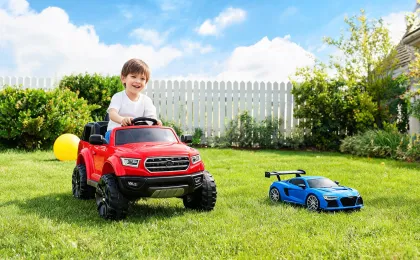
The cowboy decals are the least important part of a cowboy truck-and-trailer Power Wheels. That sounds backwards when the aisle is designed to make you fall for the stars and the little lasso on the grille. But the theme does nothing for how the vehicle handles, how long it lasts, or whether your child can reach the pedals safely. The real decision is the voltage and the size class, because those determine whether the toy fits your child now and stays usable beyond the first season. You can bolt a saddle on a poorly matched vehicle and it still won't fix a child who is too small for the speed or too heavy for the chassis. So separate the paint from the engineering and judge the toy the way you would judge a car seat: by fit and by limits.
The cowboy look is fine — but the voltage is what you're really buying
Those painted-on stars and the little lasso on the grille are what catch your eye, but they are the least important part of a cowboy truck-and-trailer Power Wheels. The theme does nothing for how the vehicle handles, how long it lasts, or whether your child can reach the pedals safely. What actually matters is the voltage and the size class, because those determine whether the toy fits your child now and stays usable beyond the first season. You can bolt a saddle on a poorly matched vehicle and it still won't fix a child who is too small for the speed or too heavy for the chassis. So separate the paint from the engineering and judge the toy the way you would judge a car seat: by fit and by limits.
Picture yourself in the store with a three-and-a-half-year-old who weighs forty pounds and has already spotted the trailer. The price tags sit close together, and both models scream western adventure. One is a 6-volt truck with a detachable trailer; the other is a 12-volt single-seater without it. Your child wants the trailer, you want the longest use for your money, and the driveway has a slight slope. This is the moment where parents split: those who buy the cooler-looking vehicle and hope, and those who make a quick spec check before leaving the aisle. The age stickers are tiny and the features are buried in fine print. You need a filter that works before you reach the register.
Here is the question that settles your choice: what does the brand itself say is the first thing to check? Not price, not decals, not even the trailer—the age band. Fisher-Price's official Power Wheels page organizes every ride-on by age, from birth through five-plus, which tells you the company expects you to start with the child's age. Skip that step and you end up with a toy either too slow to be fun by next summer or too fast to be safe this one. The next section shows how those age bands translate into voltage and weight limits.
Age bands and voltage: the brand's own first filter
The first buying rule for a cowboy truck-and-trailer Power Wheels is to match voltage and size to the child's current age and weight, exactly as the brand's own age bands suggest. Voltage controls speed and torque. A 6-volt ride-on keeps speeds low enough for a three-year-old, while a 12-volt unit pushes faster and handles hills better but demands more coordination. Weight matters just as much: if the child is too heavy for the chassis, the wheels strain, the motor overheats, and the battery dies faster. Age bands bundle these factors because a three-year-old's reflexes and leg reach differ sharply from a five-year-old's. The brand knows that a toy that scares a child ends up in the garage, and a toy that is outgrown in months is money wasted.
The proof that age comes first is on the brand's own navigation. On the official Power Wheels page, Mattel's shop sorts the catalog by 'Shop By Age' with bands reading 6-12 Months, 1-2 Years, 3-4 Years, and 5+ Years, right alongside vehicle categories. That layout is not decoration; it tells you that the child's age band is the primary filter for every ride-on, including a cowboy-themed truck. When a manufacturer organizes its whole storefront that way, you should check the age sticker before comparing anything else. It also explains why a 12V single-seater can be wrong for a small three-year-old: the brand's own ladder says that child belongs in the 3-4 band, where 6V is typical.
What this means is that you can convert your child's age and weight into a voltage range before you look at the trailer. If your child is three and weighs forty pounds, the 3-4 Years band points to a 6-volt platform. If your child is five or heavier, the 5+ band opens the door to 12-volt models. The implication is not that the 6V is 'less' than the 12V; it is that each voltage has a window where it works well. Buying outside that window creates the two most common regrets: the too-fast vehicle that sits unused after two crashes, or the too-slow one that bores the child by spring. Let the age band set your upper limit, then use weight as a tiebreaker.
Trailer trade-offs: fun vs. turn radius and tip risk
At the same budget, the real fork is not the paint job; it is whether you take the 6-volt truck with a detachable trailer or the 12-volt single-seater without one. The 6V trailer set wins on charm and gives your child the imaginary ranch life they want, but it adds length, weight, and a second set of wheels that change how the truck drives. The 12V no-trailer model wins on speed and hill climbing, but it loses the trailer your child already loves and often costs more. The deciding factor is not which looks more impressive; it is where your child will drive and how stable you need it to be. On flat, open pavement, the trailer is pure fun. On a sloped or uneven driveway, that same trailer becomes a stability problem the moment the front wheels turn sharply.
The safety logic for taking the trailer seriously comes from a lesson parents learned with car seats. Consumer Reports explains that the federal child-seat standard now includes side-impact collision testing, driven by the fact that more than 100,000 children were injured in traffic collisions in 2022. The lesson is not that a Power Wheels trailer is a crash risk; it is that safety expectations have shifted from 'does it have a seat belt' to 'has it been tested for the worst case.' Apply that to the trailer: a trailer that wobbles on uneven ground is the ride-on equivalent of a poorly engineered side structure. That is why a detachable trailer with a positive lock beats a fixed long trailer on a yard with any slope.
The rule of thumb: choose the 6V with trailer only if your child is in the 3-4 age band, weighs under the model's limit, and will drive mostly on flat pavement where you can supervise the turning radius. Choose the 12V without a trailer if your child is closer to five, heavier, or your yard slopes enough that a long trailer would tip. If you cannot decide, detachability is the tiebreaker—a model that lets you remove the trailer on uneven days gives you both options in one box. That flexibility is worth more than extra inches of plastic, because it lets the toy adapt to the driveway.
Why your pre-ride checklist matters more than the decals
The most common mistake is assuming that bigger and more expensive is automatically a better long-term investment. That sounds reasonable until you watch a three-year-old on a 12-volt truck that is too fast for their reflexes; the child either freezes at the first bump or jerks the wheel and tips it. In reality, a 6-volt trailer set can be perfect for a three-year-old while a 12-volt single-seater would be unsafe to manage. The 'grows with them' logic fails because children outgrow the emotional appeal of a toy long before they outgrow the size, and a toy that scares them gets abandoned. So the first filter should be 'fits now,' not 'a good deal for five years.' You can trade up later, but you cannot fix lost confidence with a bigger battery.
The same regulatory shift that changed car-seat testing applies to your pre-ride habits. The federal standard now includes side-impact testing because crashes at an angle are especially dangerous; Consumer Reports notes that two-vehicle collisions account for the most deaths, and getting 'T-boned' is more dangerous than front or rear impacts. That mindset transfers: before the first ride, apply an inspection-before-use routine just as you would with a car seat. The evidence does not mean your toddler's truck is a crash risk; it means you should treat the two-minute check as non-negotiable. A loose battery screw or a cracked tire is the equivalent of a worn harness—minor until it is not.
Build a two-minute pre-ride check into the routine. Start with the battery screws: tighten them once a week because vibration loosens them faster than you expect. Next, check the trailer bolts and the hitch pin; a rattle or sway in the trailer almost always means a loose bolt, not a broken toy, and a quarter-turn with a wrench fixes it in five minutes. Finally, look at the tires for cracks or flat spots, especially if the truck sat in the sun or a cold garage. Run the same check after every few rides, not just after unboxing, because a wobbly wheel or a dying battery is exactly what makes a child lose interest. This checklist prevents most 'it's broken' moments.
The verdict: match the child, then the trailer, then the theme
The verdict: buy the 6-volt cowboy truck with the detachable trailer for a child in the 3-4 age band who weighs within limit and will drive on flat pavement, and skip the trailer if the yard slopes or the child is over the weight spec. The theme matters only after the voltage matches and the trailer is stable. A 12-volt single-seater without a trailer is the right call for a five-year-old or a heavier child on grass or hills; the extra speed is useful then. You are not buying a toy truck; you are buying a short window of age-appropriate independence. Every dollar spent on speed that exceeds that window buys fear, frustration, or a very expensive dust collector.
Let the boundaries be explicit. For a three-year-old, 40-pound child on a slightly sloping driveway, the 6V trailer model is acceptable only if the trailer can be removed for slope days and the hitch locks positively; if it does not lock, choose the no-trailer 12V only if the child is tall enough and you can cap the speed. For a five-year-old, 50-pound child, the 12V without a trailer handles grass better, and the missing trailer is a minor loss because the child will invent tricks a trailer would hinder. Budget does not override fit: a cheap 12V on sale is wrong if it does not match the child's age band. When fit is right, price and theme become secondary.
You came in wanting a cowboy truck-and-trailer; you will leave with a decision rule that works for any future ride-on. Match the child first, then the trailer, then the theme. If the child is three, the 6-volt with a locking, detachable trailer is the sweet spot on flat pavement; when the driveway tilts, pop the hitch off and you have a safer single-seater. If the child is five or the yard slopes, let the trailer go and take the 12-volt speed. The decals will fade, but a child who learned to steer without fear on a vehicle that fit from day one will keep that confidence long after the battery dies. That is the payoff of checking the voltage before the paint.
The right cowboy truck-and-trailer Power Wheels fits your child's age today, locks securely when the trailer is on, and loses the trailer when the ground gets rough.

Miriam Adler
Miriam Adler is an educational and STEM toy analyst specializing in busy boards, Montessori-style manipulatives, learning towers, sound books, reading pens, pretend-play sets, and early learning toys. She applies ASTM F963 and IEC 62115 methods while evaluating small-part hazards, accessible edges, switch durability, sound output, battery access, pull force, and age-appropriate task complexity. Her work helps parents, retailers, and product teams choose learning products that align developmental goals, supervision needs, interaction design, and the intended age stage.